Learn dynamic sketching and watercolor techniques for c…
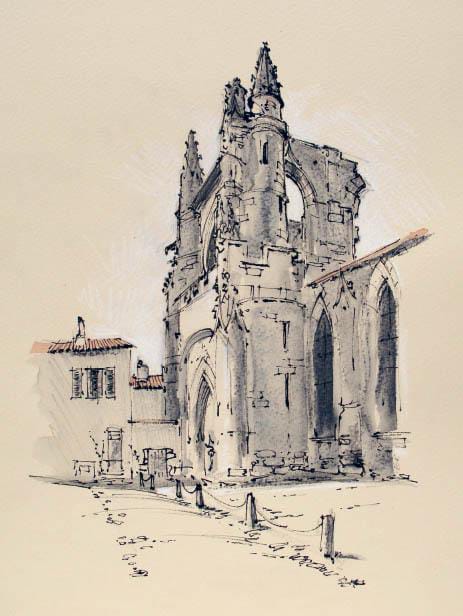
Because I’m always thinking in terms of story, I look for buildings with a story to tell. Whether it’s a tranquil café, a busy intersection, or an intricately detailed cathedral, there’s always a story being told. These buildings become individual characters in a city. It helps me to see architecture as character. Maybe a particular structure resembles an exhausted old man, or a proud soldier, or an elegant movie star.
Once you start painting a personality rather than bricks, stone, and windows, your sketches take on new life. Each line, each brushstroke becomes imbued with the personality you are portraying.
This idea can be applied to anything you sketch. Mountains famously look like sleeping giants, and trees have multiple personalities. The idea is to sketch these personalities, and to see everything around you as a personification with unique characteristics.
Draw some simple squiggles on a page. These may seem meaningless on their own. But, like individual notes on a page, when they’re in tune with each other, they describe a symphony.
Allow yourself the freedom to suggest details, rather than dogmatically explain everything. Your sketch is a conversation, not a lecture.
Composition is a method of guiding a viewer’s eyes into and through a piece. When we look at paintings, we don’t take them all in at once. We read images in a certain order, like reading a book. Our eyes move in a dynamic sequence around a piece, seeing one area first, then moving on to secondary points of focus and lesser details, returning again to the main focal point. In truly great compositions, our eyes move around a painting, unfolding details, discovering secrets. We have the power to invite a viewer in and gently guide them around a piece.
Varying the colors within your shadows is important. Shadows aren’t just one solid wash of color. It’s much more interesting to push other colors into them, combining cool and warm colors within the same part of a shadow.
We’re also not only painting the color of an object. It’s one thing to paint a gray roof or a beige chimney, but to paint the light that’s reflecting off surrounding objects is much more interesting. To paint the temperature of the day, to paint the mood we want to convey can shift our thinking and add dimension to our work.
The key to improving at any skill is to develop the talent for improving technique. Fall in love with the process and the results will take care of themselves.
Everything you sketch tells a story: a story of a time and place, a memory, a dream, a mood. Sketches are an energy transfer. What you feel at the time of creation is translated directly onto the paper. It can be a mysterious process, but shining a light on this mystery gives clarity without diminishing its power.
When I’m walking around my favorite neighborhoods looking for something to sketch, I imagine what a particular view would look like on a movie screen. I’m always looking for the most dynamic angle, the unexpected perspective, the unique vantage point from which to sketch. It’s not enough to paint a pretty building. We’re telling a story, and our choice of viewpoint says just as much as the subject itself. A viewer should lean in, wanting to know the story.